
In today’s digital world, having a beautiful website is like owning a gorgeous storefront on a deserted back street. No matter how great your products or services are, if people can’t find you, you won’t make any sales. That’s where Search Engine Optimization (SEO) comes in.
SEO is simply the process of making your website as attractive as possible to search engines like Google, so that when people look for things you offer, your site shows up at the top of the list. Think of SEO as your website’s 24/7 digital salesperson and visibility manager.
This guide will break down exactly what SEO is, how it works in simple terms, and why it is absolutely vital for the survival and growth of your website and business.
What Exactly is SEO?
SEO stands for Search Engine Optimization.
Search Engine: This is the tool people use to find information online—Google, Bing, Yahoo. Google is by far the biggest, so when we talk about SEO, we are usually focusing on what Google wants.
Optimization: This means making changes to your website so that it meets the “rules” and preferences of the search engines. It’s like polishing your store windows and organizing your shelves so customers (and the search engine inspector) have a great experience.
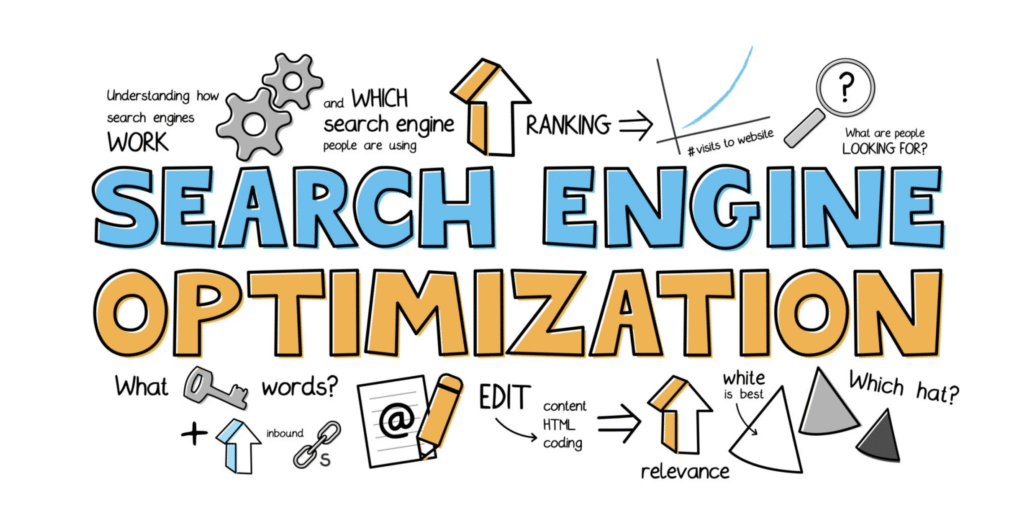
In its simplest form, SEO is the practice of increasing the quality and quantity of traffic to your website through organic search results.
The word “organic” is key. It means you are not paying for the clicks (that would be advertising, or PPC). These are the free, natural results that pop up when you search for something. Ranking high in these organic results is the main goal of SEO.
How Does a Search Engine Work?
To understand SEO, you first need to know how search engines decide what to show you. It happens in three main steps:
Crawling: Google has tiny robots called spiders or crawlers that constantly explore the internet. They start at a few known web pages and follow the links on those pages, discovering new pages and websites along the way.
Indexing: When a spider finds a page, it reads the content, pictures, videos, and code. If the page is deemed good and useful, Google stores it in a massive database called the Index. Think of the Index as a giant library where Google keeps copies of every good web page it has found. If your page isn’t in the Index, it can’t show up in search results.
Ranking: When you type a search query (like “best coffee near me”), Google quickly scans its Index for all the pages that contain relevant information. It then uses a secret, complex algorithm (a set of rules) to score and rank those pages, putting the absolute best results at the very top. SEO is the work you do to convince Google’s algorithm that your page is the absolute best result for a specific search.
Part 2: Why Does Your Website Need SEO? The Crucial Benefits
If your business relies on customers finding you online—which nearly all do—then SEO is not optional; it’s the foundation of your long-term marketing success. Here are the core reasons why your website needs it:
It Drives Free Traffic (The Best Kind!)
Visibility = Traffic: Most people never click past the first page of Google results. In fact, the top three organic results get the vast majority of all clicks. If you’re on page 2 or beyond, you are invisible. SEO helps you climb that ladder.
Sustainable and Cost-Effective: Unlike paid ads, where the traffic stops the second you stop paying, organic traffic earned through SEO is free and sustainable. A piece of content you optimize today can continue bringing you visitors for years without continuous spending. For small businesses, this is huge!
It Builds Trust and Credibility (Authority)
The Google Stamp of Approval: Users inherently trust Google. When Google places your website at the top of its search results, it’s like a powerful recommendation. Users see high-ranking sites as more trustworthy, authoritative, and credible.
E-E-A-T: Google even has a framework called E-E-A-T (Experience, Expertise, Authoritativeness, and Trustworthiness) that it uses to judge the quality of a website. Good SEO practices, like creating high-quality, truthful content and earning links from other trusted sites, directly improve your E-E-A-T score.
3. It Brings You the Right Customers (Targeted Traffic)
Matching Intent: SEO isn’t just about getting more traffic; it’s about getting the right traffic. When someone searches for “repair leaky kitchen faucet,” they have a clear problem. If your website is a plumbing service that ranks #1 for that term, the visitor is highly likely to become a paying customer. This is called targeting search intent.
High Conversion Rates: Because organic visitors are actively searching for a solution you provide, they are much closer to making a purchase than someone who just stumbled upon an ad. This means organic traffic often has the highest conversion rate (visitors turning into customers).
4. It Improves the User Experience (UX)
Google Rewards Good Websites: Google wants to give its users the best possible experience. Therefore, a major part of SEO is making your website fast, easy to navigate, and safe.
Mobile-Friendly: Since most people search on their phones, a key SEO factor is being mobile-friendly. A website that loads quickly and looks great on a smartphone will naturally rank higher. When you invest in SEO, you are simultaneously investing in a better experience for your human visitors.
5. It Gives You a Competitive Edge
Outrank the Giants: Even if you’re a small local business, smart SEO can help you compete with larger national companies who might not be focused on local or niche keywords. By optimizing for specific, relevant terms, you can steal traffic and market share from competitors.
The Three Pillars of SEO (How to Do It)
SEO might sound complex, but it can be broken down into three main areas of work. If you work on all three, your website will climb the ranks!
Pillar 1: On-Page SEO (The Content on Your Pages)
On-Page SEO refers to everything you do directly on your website pages to help search engines understand what your content is about.
A. Keyword Research and Intent
Before writing anything, you need to know what words your customers are actually typing into Google.
Keywords: These are the words and phrases people use in search engines (e.g., “best dog food for puppies,” “how to fix a clogged sink”).
Search Intent: You must understand why the person is searching. Are they looking for Information (a blog post on ‘how to’), Navigation (a website’s homepage), or a Transaction (a page to buy a product)? Your page must match their intent.
B. High-Quality Content
Google’s top rule is: Create content for people, not for search engines. Your content must be:
Helpful and Unique: It should answer the user’s question completely and be better than what your competitors have. Don’t copy others!
Easy to Read: Use short paragraphs, bullet points, and clear headings.
Relevant Keywords: Use your chosen keywords naturally in the text, especially in the first paragraph, but never “stuff” them in unnaturally
C. HTML Elements (The Stuff the Code Sees)
These are the elements that Google looks at closely, even if a user just glances at them:
Title Tag: This is the clickable headline in the search results. It should be compelling and include your main keyword near the beginning.
Meta Description: This is the short summary text below the title in the search results. It acts as an ad copy—it won’t help you rank, but it will convince people to click.
Header Tags (H1, H2, H3): Use these to structure your content like an outline. Your H1 should be the main topic title (use only one!), and H2s and H3s are subheadings to break up the text.
Pillar 2: Technical SEO (The Website’s Engine)
Technical SEO focuses on the behind-the-scenes structure of your website, making sure the search engine robots can easily crawl, index, and understand it.
A. Site Speed (Fast is Best)
Loading Time: Websites that load slowly frustrate users and Google. A slow site will rank lower. Tools like Google PageSpeed Insights can tell you how fast your site is and suggest improvements.
B. Mobile-Friendliness
Mobile-First Indexing: Google primarily uses the mobile version of your website to determine its ranking. Your site must be responsive, meaning it looks and works perfectly on any device (phone, tablet, desktop).
C. Site Structure and Internal Links
Internal Linking: This is when you link from one page on your site to another page on your site. It helps users find related content and tells Google which of your pages are most important.
XML Sitemaps: This is a list of all the pages on your website that you want Google to know about. You submit this to Google Search Console to help the spiders crawl your site efficiently.
D. Security (HTTPS)
A secure website (one that uses HTTPS instead of HTTP, shown by a padlock in the browser bar) is a basic requirement for trust and is a small ranking factor.
Pillar 3: Off-Page SEO (Reputation and Authority)
Off-Page SEO refers to actions taken outside of your own website to impact your rankings. The main goal here is to build your website’s reputation and authority.
A. Backlinks (The Votes of Confidence)
What are they? A backlink is simply a link from another website back to yours. Google treats backlinks like votes of confidence. If a major news site links to your blog post, that’s a powerful vote telling Google your content is valuable and trustworthy.
Quality over Quantity: Not all links are equal! One link from a high-authority, famous, and relevant website is worth more than a hundred links from low-quality, spammy sites. The process of getting these high-quality links is called link building.
B. Brand Mentions and Social Signals
Brand Authority: If people are talking about your brand—mentioning your business name on blogs, forums, or social media—Google takes notice. This buzz and recognition contribute to your overall authority.
Social Media: While likes and shares on Facebook or Instagram may not directly affect your rankings, they increase visibility, which can lead to more people seeing and linking to your content, which does affect your SEO.
C. Local SEO (Especially for Local Businesses)
Google Business Profile (GBP): If you have a physical location or serve a local area, optimizing your GBP is crucial. This is the profile that makes your business show up on Google Maps and in the “local pack” (the box with 3 business listings and a map) when someone searches “plumber near me.”
Reviews: Good customer reviews on your GBP and other platforms significantly boost your local SEO and credibility.
The Dangers of Ignoring SEO
The biggest mistake a website owner can make is to think they can skip SEO. Here is what happens if you ignore it:
You Become Invisible: Your beautiful website sits on page 5 or 10 of Google. You are essentially invisible to 99% of your potential customers.
You Hand Business to Competitors: For every search related to your business that you don’t rank for, a competitor does. They get the free traffic, the trust, and the sales.
The Problem Snowballs: SEO success builds upon itself. High rankings lead to more traffic, which leads to more social shares and backlinks, which leads to even higher rankings. If you don’t start, your competitors’ gap will only get wider and wider.
You Become Dependent on Paid Ads: Without organic traffic, you will be forced to rely entirely on paid advertising (PPC) to get customers. This is expensive, unsustainable, and often less trusted by consumers.

